|
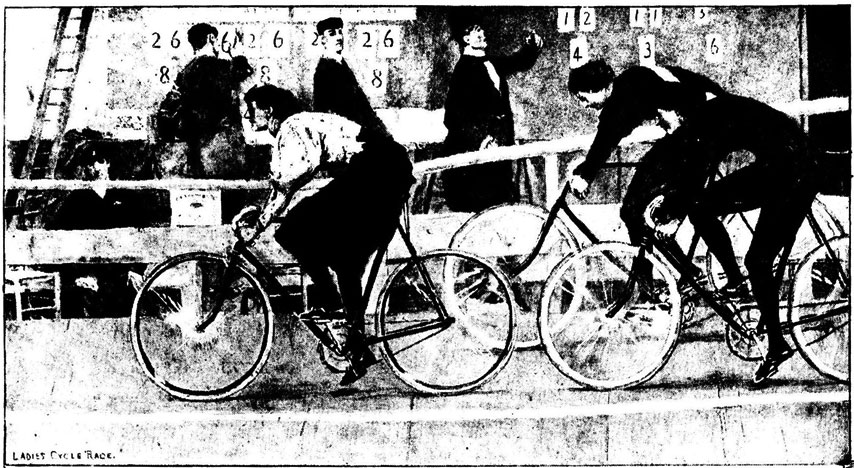
The only photograph found so far of any 19th century indoor cycle racing of any type. This was published in January 1897 and shows the Ladies’ Christmas racing at the Royal Aquarium [The Graphic (London, England), Saturday, January 2, 1897; Issue 1414].
My interpretation is that it shows one the English riders leading two of the French competitors as they pass the three lap-scorers - who are updating the distances covered at the scoreboard. To the left a ladder provides access to the top section of the scoreboard. As for the track, the boards are laid at right angles to the riders and there is white line that all the riders are riding above. Looking at the fence, the riders seem to be exiting a bend and to be riding anti-clockwise.
But quite how the photographer managed stop the action using a single-shot glass-plate camera indoors is hard to work out - I have problems even when using a pro-spec DSLR.
|
|
Before 1895
According to various reports, women’s cycle racing in Europe seems to have become recognised in some semi-official form around 1893. In that year at least three unpaced world hour records were set by women. Other researchers have found reports of records by - de Saint Sauveur with 26.012 km in July; Renée Debatz with 28.019 km in August and Hélène Dutrieu with 28.780 km in October - with a number of paced records in between. [Thanks for the info]
However one of the reasons for creating SixDay.org.uk is to publish contemporary reports that confirm, or refute, the stories in general circulation today. And it is becoming clear that there certainly were earlier races - including races in the USA before 1890 (see below), Sunderland and Sheffield in 1889, and this snippet from the English Midlands .. “28-May-1890, Molyneux Grounds, Wolverhampton ... qualifying heats of the one mile [professional] handicap ... In heat 10 Miss Lottie Stanley, a lady bicyclist of America (355), made a fine race on an ordinary machine, in male attire, against C Kightley, Northampton (170), and won in 2 min. 37 3/4 sec.”.
|
|
1895
It is commonly quoted that the first organised race for ladies was in London - and a six day; hardly the easiest of first races. Certainly a British rider - Miss Monica Harwood - is recorded as the first winner there in November 1895. However the claim of being a world first looks like an “urban myth” when you consider this report -
“The six-days bicycle race is to begin on Monday, February 11, at Madison Square Garden, New York, and will end on Saturday evening, February 16. Among the entries are Miss Elsa [or Elsie] Van Blumen, the present champion, and the Misses Jessie Oaks, Lottie Stanley, Hattie Lewis, Lulu Hart, Helen Baldwin, Maggie McShane, Hilda Suallor, Kitty Brown, May Allen, and Louise Armaindo.” Sporting Life (Philadelphia, PA, USA), 13-Feb-1889. A separate report gives the result as - “Lottie Stanley, 624 miles 440 yards; Elsa Van Blumen 592.440; Jessie Oaks 532; Suallor 515.880; Hattie Lewis 490.1,320”
This is six years before the first London Six - and since Miss Van Blumen is already the “present champion” it cannot be the first such event. Note that the start list includes the same Lottie Stanley that was racing the men in Wolverhampton the following year. And Miss Stanley also gets a mention here - “Nine of the speediest lady cyclists in the country will contend at the Claremont avenue rink on Christmas Day, in a 100 miles race, commencing at 2 pm. Lottie Stanley, a famous rider will appear.” The Brooklyn Daily Eagle (USA), Saturday 22-Dec-1888. So Miss Stanley was already famous in 1888. And there is evidence that these US ladies also raced in the England 1887 and 1889. One press report states that the 18 hour (6 x 3hrs?) cycling record of 261.5 miles was beaten by both Lottie Stanley (269 miles) and Jessie Wood (263 miles) on Saturday 9-Nov-1889 at Sunderland Skating Rink. Other reports describe the long-distance indoor race in Sheffield from 24 to 28 December 1889 - a “Five Day” race More...
The Sheffield racers of 1889 included Louise Armaindo [also listed as Armanido / Amiaindo / Aimaindo], who had been reported - back in 1882 - as being born near Montreal, Canada and to have ridden 617 1/2 miles in a six day race (12 hours per day) at St. Louis. So this now becomes the earliest Six with a lady competitor.
However back to London in 1895 the women cyclists were limited to riding four hours a day - but Miss Harwood still rode some 371 miles - even though she was reported as being just sixteen years old. In fact she was more likely eighteen - but still very young for long-distance racing. But surprisingly it was just the first race in a series. A first race that was billed as a Twelve Day race - a double six day! More...
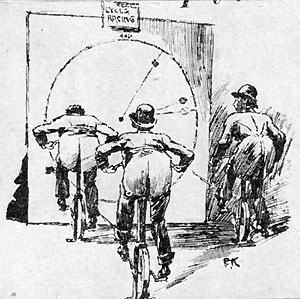 It would have been easy to assume that the riders in this first race were simply ladies that had one of these new miniature bicycles and wanted to try something exciting. Entering in response to a newspaper advertisement or story with limited notice and little preparation. Yet this seems a bit unlikely given the number of overseas entrants. And tackling six days of racing with an early safety on a small, indoor track seems to imply that the entrants were, at least, serious amateurs. Something like the level of riders entering a major sportive event of today. But with cash prizes on offer they would not have remained amateurs for long. Their interest may have been started by the US ladies racing in England a few years before. So any spur-of-the-moment riders were, most likely, limited to the “penny a lap” racing machines that were also in use at the Westminster Aquarium (right). It would have been easy to assume that the riders in this first race were simply ladies that had one of these new miniature bicycles and wanted to try something exciting. Entering in response to a newspaper advertisement or story with limited notice and little preparation. Yet this seems a bit unlikely given the number of overseas entrants. And tackling six days of racing with an early safety on a small, indoor track seems to imply that the entrants were, at least, serious amateurs. Something like the level of riders entering a major sportive event of today. But with cash prizes on offer they would not have remained amateurs for long. Their interest may have been started by the US ladies racing in England a few years before. So any spur-of-the-moment riders were, most likely, limited to the “penny a lap” racing machines that were also in use at the Westminster Aquarium (right).
As more press reports have emerged for 1895 it has become clear that women were racing almost every day (Sundays excluded) from 18 November until the 28 December - with two Sixes and an “Eleven Days” plus races in Birmingham and Sheffield. A programme that even a modern professional cyclist would find “busy” - but even more was to follow the next year.
|
|
1899-1900
No sixes found so far even though Ladies’ racing did clearly continue over shorter distances with references to some of the English riders competing on outdoor tracks. For example there were a thousand spectators at a Ladies track meeting at Putney Velodrome in May 1898. It could be, of course, that the sixes were simply not reported in the newspapers that are available online. And so far specialised magazines such as Bicycling Times (1877-1883), Cyclist (1880-1903) and Cycling (started in 1891) have not made it into digital format - making searching a time consuming and expensive process. In France Veloce-Sport only ran from 1885 to 1897 so that option is also unavailable for 1899 and later.
1901
A few brief mentions in the press of more sixes held indoors and again at the Royal Aquarium. More...
1902 onwards
No women’s Six Day races are officially recorded - and no press cuttings have been found so far for any ladies’ sixes after those of 1901. In 1903 the Royal Aquarium was closed and demolished so removing another of London’s cycling venues.
Hopefully some of the competitors’ backgrounds and racing careers will continue to emerge - and help explain a bit more about the early world of women’s bicycle racing.
|

















































































 1896
1896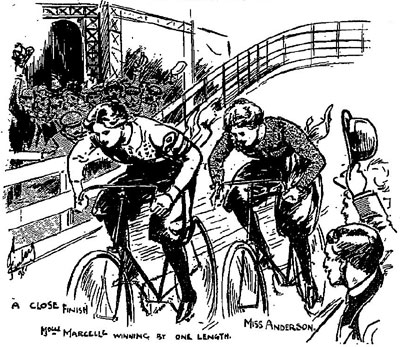 1898
1898